
The Fleur-de-Lis Bowl
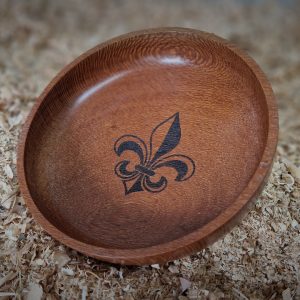
Vessel of the Hidden Line
It began, as most sacred things do, with simple intention. A piece of Meranti, warm and rich in tone, turned slowly on the lathe under steady hands. But as the form took shape — rounded, open, vessel-like — I felt something deeper calling to it. Not a bowl for holding, but for remembering. A relic to honour one of the most whispered stories in all of human history.
Engraved at its centre is the fleur-de-lis — symbol of royalty, yes, but also of secrets. Of bloodlines concealed. Of the sacred feminine hidden beneath centuries of dust and doctrine.
For those who know the tale — or feel it stir something in their bones — this piece speaks not of legends, but of possibility. That Mary Magdalene, far from being a sinner in scarlet, was in truth a priestess, a companion, and perhaps… a mother. That the Holy Grail was never a golden chalice, but a womb — a vessel of blood. The true Sang Réal.
“The Grail is literally the ancient symbol for womanhood... the chalice represents the womb — a vessel that carried the bloodline of Jesus Christ.”
– Sir Leigh Teabing, The Da Vinci Code
There are whispers — older than scripture, buried in gnostic texts and echoed in The Passover Plot — that the crucifixion was not what it seemed. That it was orchestrated, timed, designed not as an ending, but as a divine sleight of hand. A staged death… to protect a living legacy. A bloodline.
And when that bloodline was threatened — by the Roman-backed Herodian kings, who had seized the throne of David without birthright — it fled. Carried across waters in silence and in grief. Magdalene, exiled and pregnant, vanished into the mists of Gaul. But she left behind a current. A pulse. A line. One that would give rise to the Merovingians, and one that the Church would spend centuries trying to erase.
This bowl was turned in memory of that truth — or that sacred maybe. The form is deliberate: curved like the Earth, like the womb, like the Grail itself. It is a vessel, not of fact, but of feeling. Of knowing. A reliquary for the idea that divine love once took human shape — and that it may still echo in blood and breath.
“History is always written by the winners. When two cultures clash, the loser is obliterated… and the winner writes the history books.”
– Dan Brown, The Da Vinci Code
Place this bowl on your altar, or simply in your hands. Let it hold your offerings, your prayers, your silence. It is not about belief — it is about reverence. For the feminine once cast aside. For the voices that were buried. For the possibility that love and legacy are the real Grail we’ve been seeking all along.
This is The Fleur-de-Lis Bowl.
It remembers what was nearly lost.