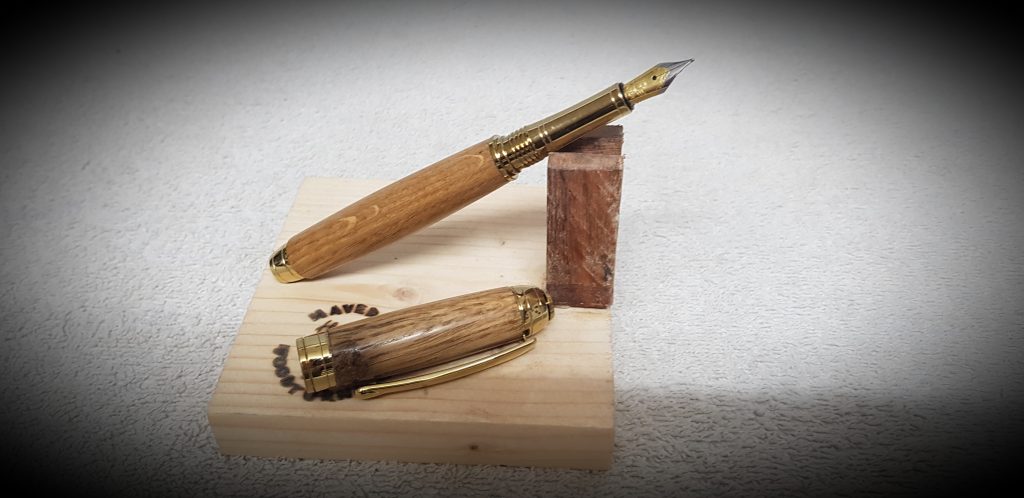
The R.M.S. Olympic Fountain Pen

A Piece of History, Reimagined
Crafting this fountain pen was never intended to be decorative alone.
It was an act of continuity — a way of carrying forward something that deserved to endure.
The timber used in this pen once formed part of the first-class deck panelling aboard the RMS Olympic, the renowned sister ship of the RMS Titanic. While history remembers Titanic for her tragedy, Olympic is remembered by those who know her story for her longevity, resilience, and service. She carried generations of passengers across the Atlantic, served with distinction during wartime, and lived a full life before being retired with dignity.
When Olympic was dismantled in the 1930s, portions of her interior were salvaged — not as curiosities, but as materials worthy of reuse. The wood itself reflects that philosophy. Mature, stable, and quietly elegant, it bears the marks of an era when craftsmanship was deliberate and enduring.
Working with this timber demanded restraint. The grain tells its own story — subtle, refined, and unwilling to be rushed. Each cut was taken slowly, not to erase its past, but to respect it. The aim was never to dominate the material, only to shape it enough to allow its character to remain visible and honest.
The finished pen is smooth and warm in the hand, balanced and understated. It carries no unnecessary embellishment, because none is required. Its value lies not in ornament, but in provenance — in the knowledge that this was once part of a ship built at the height of Edwardian engineering, designed to last, and proven to do so.
This is not a replica, nor a novelty. It is a working object made from historic material — preserved, repurposed, and returned to daily life. A small, functional fragment of maritime history, ready to be used rather than displayed.
A pen for those who value stories that don’t shout — but endure.
The Turning
The timber began as a modest piece — just over an inch square and five inches long — carefully marked, cut, and prepared. It was then divided to form the pen blanks, each one offering no margin for error. Working with material of this age and provenance brings a particular weight to the process; every decision feels consequential.
On the lathe, progress was slow and deliberate. The cuts were light, controlled, and taken at high speed — not for haste, but for precision. The wood demanded patience. Too much pressure, too much confidence, and a century of history could be lost in an instant. The final form emerged gradually, shaped more by restraint than force.
Only once the turning was complete did the character of the oak truly reveal itself. Through nine progressive grades of sanding, the surface softened and refined, the grain tightening and warming with each pass. The final finish was applied sparingly, chosen not to add gloss or spectacle, but to protect the timber and allow its natural depth to speak for itself.
What remains is not perfection, but honesty — the quiet beauty of aged oak, shaped with care and left largely to be what it already was.
Provenance & Rarity
Only two fountain pens were made from this salvaged RMS Olympic timber.
One was created as an 80th birthday gift for my wife’s uncle — a private commission, marking a significant life milestone. The second was made for myself, and it remains in daily use. No further pieces are planned. The material was limited, and the intent was never production, but preservation.
These pens were not made to be collected as objects alone, but to continue a working life — just as the ship they came from once did.